In today’s business environment, executive credibility is often assessed before the first meeting takes place. Investors search founders before allocation discussions. Enterprise buyers look up leadership teams before signing contracts. Journalists review a source’s public footprint before quoting them. Senior recruits examine company leadership before accepting a call.
According to Abhay Jain, CEO of Lindy Panels, this shift has made executive search presence a core part of modern reputation infrastructure.
“The first impression of an executive is no longer formed only through a pitch deck, a website, or a LinkedIn profile,” said Jain. “Very often, it is formed through the search result that appears when someone looks up their name.”
Lindy Panels is a firm focused on Google Knowledge Panel strategy and executive search presence, works with founders, executives, fund managers, agency owners, and high-trust professionals to structure how their public identity appears online. The company operates at the intersection of digital reputation, entity optimization, and search visibility, helping individuals and organizations create a clearer and more verifiable presence across search engines.
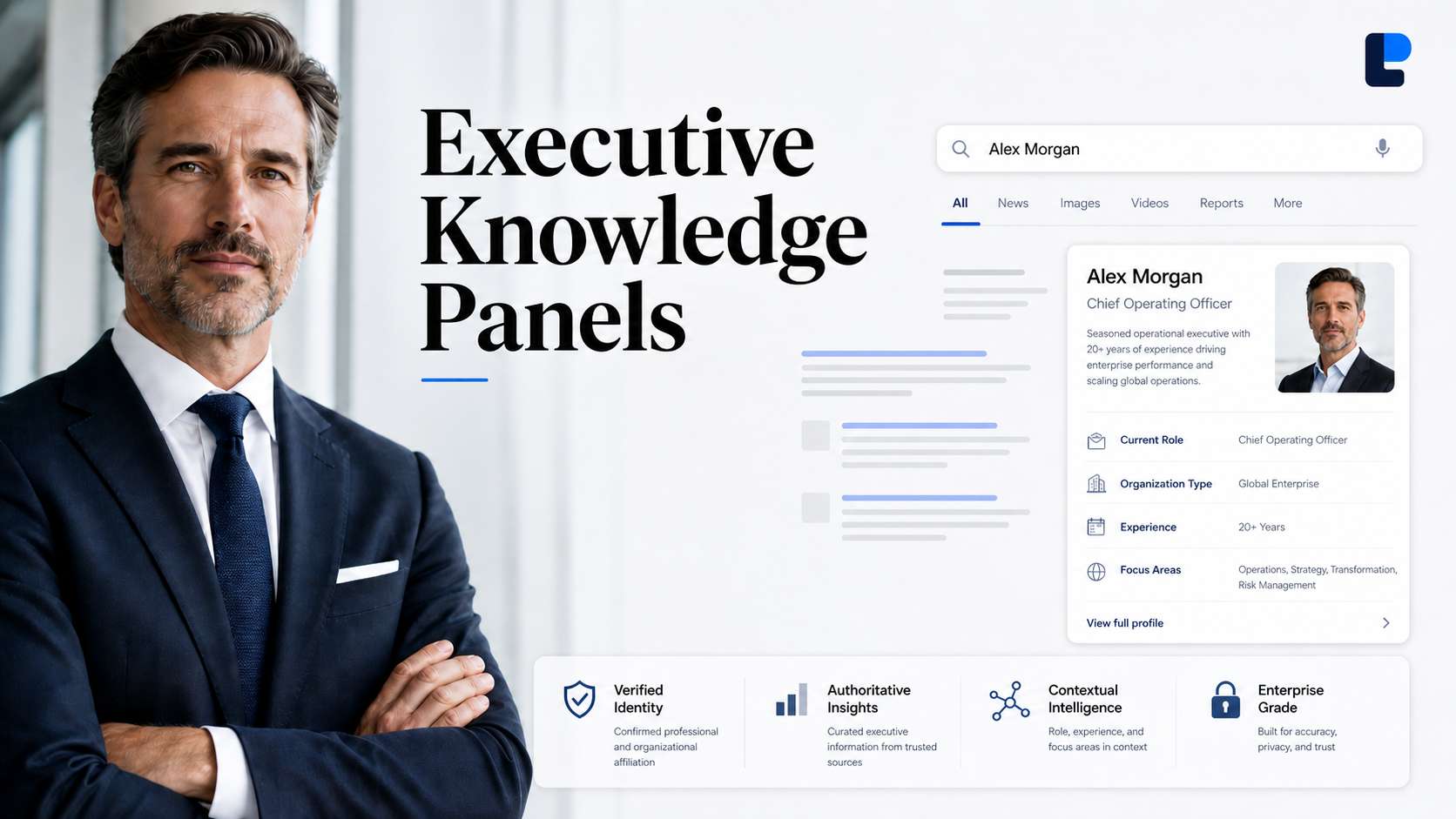
A Google Knowledge Panel is the information box that appears on Google for recognized people, companies, organizations, and public entities. For an executive, it may display their name, image, role, company, social profiles, and other publicly available details. More importantly, it signals that Google understands the person as a distinct entity rather than a disconnected collection of links, articles, profiles, and mentions.
For enterprise-facing professionals, that distinction is becoming increasingly important.
Jain said that many accomplished executives do not suffer from a lack of credibility, but from a lack of structured representation online.
“The problem we often see is not that an executive has no achievements,” he said. “The issue is that their achievements are scattered across the internet in a way that search engines, journalists, investors, and potential clients may not immediately understand.”
This is especially relevant for founders and senior leaders operating in high-trust sectors such as finance, advisory, healthcare, law, real estate, technology, and professional services. In these industries, reputation is not merely a marketing function. It influences sales cycles, investor confidence, media perception, partnership discussions, and institutional trust.
A well-structured search presence helps reduce ambiguity. It clarifies who the executive is, what organization they are associated with, what they are known for, and which public sources validate that identity. In contrast, an unclear or fragmented search result can create unnecessary friction, even when the underlying individual or company has a strong track record.
“Enterprise trust depends on clarity,” Jain said. “If a search result cannot clearly explain who an executive is, what they do, and what institutions they are connected to, that creates avoidable uncertainty.”
The rise of artificial intelligence has added another layer to the discussion. Search engines and AI systems increasingly rely on structured public information to understand people, companies, and their relationships. This means that executive reputation is no longer shaped only by what humans read. It is also shaped by how machines interpret, connect, and summarize available information.
For Lindy Panels, this makes Knowledge Panels part of a broader shift in online identity. The firm’s work typically involves entity research, public source mapping, biography refinement, schema implementation, profile consistency, and Knowledge Panel strategy. The objective is not simply to create a more attractive search result, but to help search systems understand a person or company more accurately.
Jain believes this is why executive search presence is moving from a personal branding concern to a boardroom-level reputation issue.
“For a long time, executives thought about online presence in terms of websites, PR, and social media,” he said. “Those still matter. But the deeper question now is whether the internet understands those signals as belonging to one clear, credible identity.”
This is particularly important for companies where the founder or CEO is closely tied to the brand. In founder-led businesses, investment firms, agencies, and advisory companies, the executive’s personal credibility often becomes part of the company’s commercial credibility. A stronger leadership search presence can support due diligence, shorten trust gaps, and reinforce the authority of the business itself.
Knowledge Panels are not a substitute for real achievement, credible media, strong client work, or institutional reputation. Rather, they help organize and surface existing credibility in a way that is easier for people and platforms to understand.
As digital due diligence becomes standard across enterprise relationships, structured executive identity is likely to become a more important part of reputation management. For companies competing in high-trust markets, the ability to clearly represent leadership online may increasingly influence how prospects, investors, partners, and the media evaluate them.
“Reputation is no longer only about being known,” Jain said. “It is about being understood correctly.”